

Archivo de la categoría: Arte
Talks about Mexican Art and Design at King’s College London

The Conquest of Mexico or the discussion at the opera house
By César Octavio Moreno Zayas
500 years ago, on April 22 Hernan Cortez arrived to Veracruz to start what is called the conquest of Mexico. Centuries have passed and still, we don’t see a 100% serenity in the environment of all the parts.
For example, recently the president of Mexico, Andrés Manuel López Obrador, has sent, via the Ministry of Foreign Affairs of Mexico a letter to the government of Spain, particularly the King. He asked for an official apology for the issues caused by the conquest. The letter and the rejection of it by the monarch have caused clashes and reactions on both sides of the Atlantic Ocean. Intellectuals of any type discussed and argued the pros and cons of that diplomatic movement. Some have agreed about the need for an apology, while others voted for a peaceful silence for the best of the mutual respect. The upheaval even moved scholars to dig into the archives, where they spotted a peace treaty between Mexico and Spain signed back in 1836.
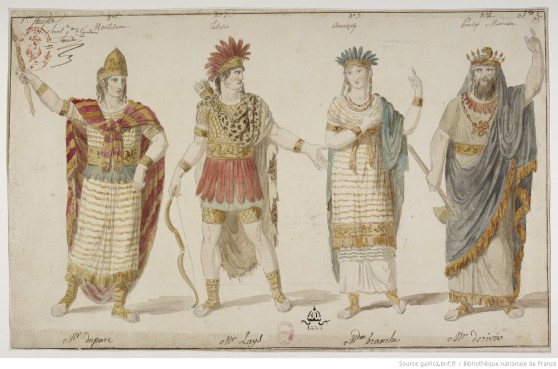
«Fernand Cortez ou la conquête du Mexique : sept pl. de costumes.» Source https://gallica.bnf.fr / Bibliothèque nationale de France.
The turmoil, diplomatic and on the media, is not new and it shows that there is still too much to work on. Some weeks ago the Mexican streaming platform Claro Video has released the documentary Malintzin; Marina, Malinche o Malintzin was the interpreter of Hernan Cortés. Via Marina, the Spaniard conquistador was able to understand and communicate his desires and plans to his allies and enemies in central Mexico. Marina is, then, considered as a traitor by some people, even the word “malinchista,” is often heard among Mexicans, who refer to the person who prefers foreign (people or goods) to Mexican ones. But, this story has another interpretation, which is highlighted in the documentary, that she did not betray her people because the Mexica people were not her people; they were in fact her enemies. In consequence, she acted according to her beliefs for the best of her community. The debate seems, then, to lie on the alliance despite inner conflicts with other cultures or segregation because of those conflicts.
Marina, Cortez, and Emperor Moctezuma are of course very polemic, and their story, as it has been said, had inspired different reactions. Different media and artistic genres have approached the subject and opera is one of them. Opera has experience at putting on a large scale stage the most interesting representation of social, political or moral issues. For example, the love adventures of Nero depicted in L’Incoronazione di Poppea by Monteverdi, the class distinctions that appear in Mozart’s Le Nozze di Figaro, the famous love story of a courtesan in La Traviata by Verdi, public opinion against one man in the dramatic Peter Grimes composed by Britten, or even a terroristic attack as it appears in The Death of Klinghoffer by Williams. Then, opera in more than 400 years has had the time to describe stories, conflicts, traumas, achievements, as well as real, ideal, sad or funny stories. The Conquest of Mexico and its characters, of course, have been in the opera as early as 1733 when Vivaldi composed his Moctezuma.
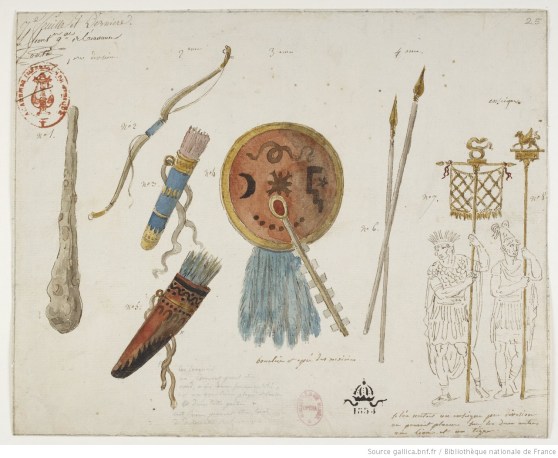
«Fernand Cortez ou la conquête du Mexique : sept pl. de costumes.» Source https://gallica.bnf.fr / Bibliothèque nationale de France.
The subject of the conquest has appeared several times through the history of opera, and one good question is: how to depict that cultural clash in opera? Because, it is not easy to display a conflict like this on a musical drama. I will try to approach to this matter by mentioning two brief examples: Graun’s Montezuma and Spontini’s Fernand Cortez.
Carl Heinrich Graun premiered his Montezuma in Berlin in 1755. The libretto was written in French by the same King of Prussia, Frederik II the Great; the text was then translated into Italian by Giampietro Tagliazucchi to be sung in the usual language of the opera in those years. Ramón Jauve-Martín considers that this work does not present the conquest as a triumph of Europe, moreover, it criticizes it and takes side with the Aztec Empire, particularly it reprimands catholic southern Europe. Thus, Frederik and Graun’s approach seems to highlight the differences between Catholic and protestants, and as Marina, they prefer to follow the attraction of the unknown culture of the Americas, rather than accept the well-known political problem in Europe 53 years after Graun’s work, another opera appeared to display a spectacle that will shake the Spanish Empire.
Fernand Cortez, ou La Conquête du Mexique composed by Gaspare Spontini, with a libretto written in French by Etienne de Jouy and Joseph-Alphonse Esménard. The opera tells a story of the conquest, which includes a love story between a daughter of the emperor Montezuma and Cortez. The work finishes with the rendition of the emperor, a peace agreement and also the Aztec monarch gives the hand of his daughter to Cortez. The work, as explained by Sarah Hibberd, reflects the political context of its premiere. It was commissioned by Napoleon I as propaganda after his invasion to Spain in 1808. The conquerors were conquered and the kings were overthrown in both cases. Then, Spontini’s conquest display not just a religious or political conflict in Europe, rather it uses a story of the past to propose or anticipate a future. The problem for Spontini and Napoleon is that this future is not going to happen, because the invasion did not increase the territories, in fact, it encouraged the separation and future creation of new countries, like Mexico.
The conquest of Mexico in conclusion cannot be labeled solely as an entertainment, but it is a complex sign made by different readings. Some of those of those readings are still present, for example in the discussions of the letter to the king. However, let’s move to Madrid, maybe we can find some ideas for a truce of this half-millennium conflict. In 2013 the Teatro Real presented a new production of Wolfgang Rihms’ Die Eroberung von Mexiko. The opera, premiered in Hamburg in 1992, has a libretto written by the composer, based on Antonin Artaud, it also includes works by Octavio Paz. The finale of this work is different, and it walks in another direction. In words of Gerard Mortier, Rihm’s opera shows that cultures must understand each other, and their encounter must conclude in harmony, not in blood. Then, we may listen to the opera, is an old genre, it has experience, and it has seen many things of the world. We might learn something from it, and find a peaceful resolution.
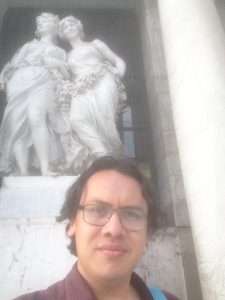 César O. Moreno Zayas is a Ph.D. Candidate in Music at The University of Nottingham, United Kingdom. He is carrying out a research on opera audiences and management. His main research areas of interests are opera history, sociology of opera, and opera production. He has recently collaborated with publications for Opera Wire, Mexican Cultural Centre and Las Nueve Musas Magazine. The production of opera is another important part in his expertise, he has produced in 2015 the premiered of the opera Eugenia by the Mexican composer Armando Ortega. Now he is working for a project of Acis, Galatea and Polyphemus by Handel for the City of Orizaba. He has presented papers at specialized congresses and institutions on music, media studies and opera at UNAM, University of Copenhagen, CENIDIM, University of Veracruz, Sibelius Academy, Lund University, and at the University of Nottingham. He is currently collaborating on a research project on independent theatre at the Mora Institute in Mexico City, and he co-coordinate at 17, Critical Studies Institute the Certificate on Contemporary Views in Semiotics: Art, Society, and Digitality.
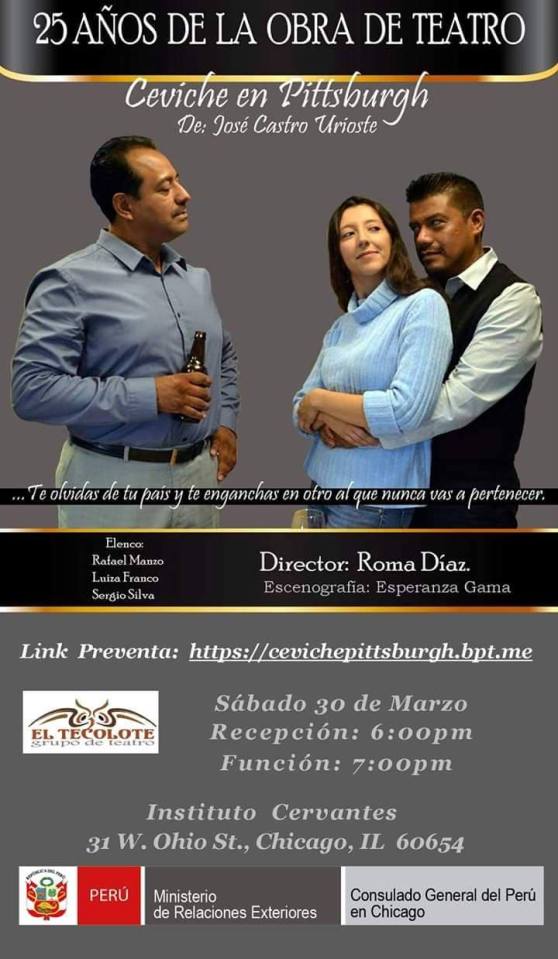
Teatro en Español en Chicago: «Ceviche en Pittsburgh» de José Castro-Urioste
«Construction Déconstruction» de Liliana Pérez
Par Mr. Antonio Rizo Ramírez
UNAM / Académie San Carlos
Mexique, octobre 2018
 «Déconstruction» n’existe ni dans le schéma du temps mécanique, ni dans l’urgence artificielle des angoisses contemporaines. «Déconstruction» signifie, selon Jacques Derrida, dévoiler les choses à travers les expériences inscrites, dans les surabondances du temps, ainsi le temps équivaut-il à quelque chose de vivant et qui fait vivre.
«Construction» est un retour vers les choses transformées par la triade: expérience-temps, chose-temps, individu-temps, jeu subtil car la création –pour un artiste- a de sérieuses conséquences. Les créateurs émettent des réserves sur ce qu’ils présentent au monde parce que c’est inédit, car même quand leurs références artistiques viennent d’un passé supposé, il est recréé dans le présent, sous l’étude des artistes référents. Les interprétations des choses vivantes en sont le résultat.
Le temps est le facteur commun qui le décante en transformant tout. La création picturale, à partir de Construction Déconstruction, est conforme et conditionnelle au présent constant contemporain ; elle fait référence à la peinture des objets mais aussi: avec et à partir des objets. Elle opère des changements de matière picturale, compris en tant que choses insérées sur le plan pictural et qui sont en même temps une matière picturale essentielle, d’une compréhension bigarrée et créative, parfois en tant que signes, parfois en tant que symboles.
 L’action picturale -pour l’artiste Liliana Pérez- ne concerne que son instinct de peindre. La philosophie et les matériaux extra-picturaux sont les pionniers utilisés dans sa vocation expressive, éléments qui rendent possibles la diversité créative et la diversité dans son interprétation des choses à sa portée.
Liliana ne fait pas que nous montrer ce qu’elle pense d’une culture volatile post-moderne ; elle nous rend complices de ses objets, ses textures, les couleurs et les compositions. Mais il est certain que ce qui est fondamentalement important, c’est qu’elle nous emporte dans son intimité artistique.
 Terremoto # 1 Zona Centro, Guanajuato, Guanajuato, México. C.P. 36000. Teléfono: 52-473-7321326. Correo electrónico: afguanajuato@gmail.com
Charla «Apreciación del arte abstracto», imparte Liliana Pérez
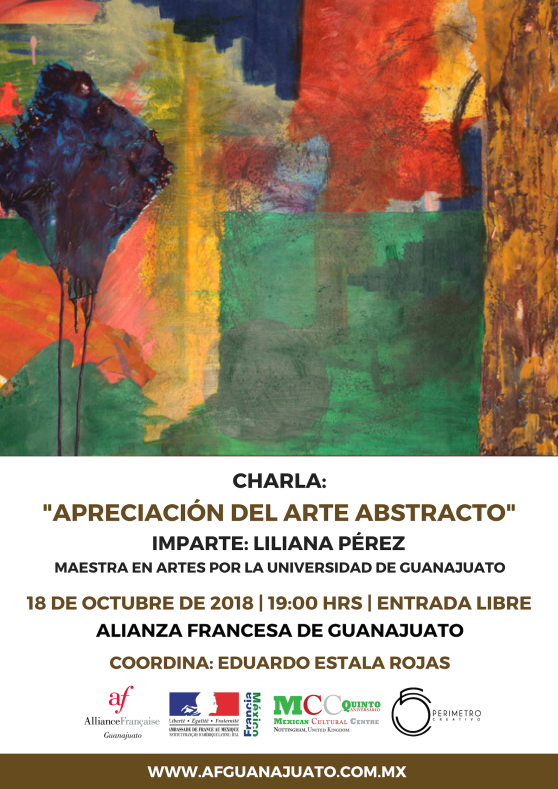
Exposición «Construcción Deconstrucción» de Liliana Pérez

Café Filosófico: “¿Qué es el arte contemporáneo?”

Pioneros en la diplomacia digital mexicana en el mundo
Por Eduardo Estala Rojas*
El Mexican Cultural Centre (MCC), Reino Unido, celebra 5 años de divulgar las aportaciones científicas, académicas, culturales y artísticas de los mexicanos a nivel internacional, siendo el primer centro digital de su tipo en el mundo y pionero en la diplomacia digital mexicana.

Eduardo Estala Rojas, director fundador del Mexican Cultural Centre (MCC), Reino Unido. Fotografía: Lidia Á. García.
El MCC funciona con las mismas características de un centro físico, ya que cuenta con una estructura administrativa y un consejo consultivo, así como un registro y una certificación del Reino Unido. La dirección de comunicación está a cargo de Lidia Ángeles García González y el consejo consultivo está integrado por Adriana E. Vera Pérez, Antonio Galván García, Carlos Jaime, Édgar Rincón Luna, María Refugio García González, Roma Díaz y Sven Ehlert. Una de las grandes ventajas de operar a través de un centro virtual y presencial, son las múltiples herramientas que hay en el internet para publicar contenidos editoriales y contar con colaboradores de diversas partes del mundo.
Nuestras sedes físicas, están en los países en donde vivimos los fundadores, consejeros y benefactores. De esta manera, no sólo estamos creando nuevos contenidos editoriales digitales sino también estamos organizando presencialmente nuevas actividades académicas y culturales en México y en el extranjero.
Breve historia del MCC

“The Mexican Cultural Centre: 15 voces de la cultura mexicana, México-Estados Unidos-Reino Unido”. Compilador: Eduardo Estala Rojas, 2014.
El 16 de septiembre de 2013, el Mexican Cultural Centre (MCC), inició sus actividades al publicar un dossier digital sobre cultura y arte que reunió a mexicanos residentes en los Estados Unidos, Reino Unido y México. Después se realizó en el 2014 un libro electrónico: “The Mexican Cultural Centre: 15 voces de la cultura mexicana, México-Estados Unidos-Reino Unido”. Compilador: Eduardo Estala Rojas.
El 30 de enero de 2014, José Antonio Meade Kuribreña, secretario de Relaciones Exteriores de México (2012-2015), reconoció la importante labor diplomática del MCC: “Un reconocimiento al Mexican Cultural Centre (MCC), Reino Unido, por lograr conjuntar una pluralidad de expertos colaboradores, cuya participación deriva en la excelencia de los trabajos editados por ese centro bajo su digno cargo”.
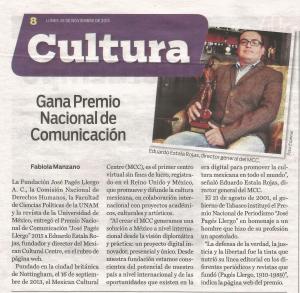
«Gana Premio Nacional de Comunicación». En el periódico mexicano a.m. , 2015.
El 12 de noviembre de 2015, en el Club de Industriales de la Ciudad de México, recibió el Mexican Cultural Centre (MCC), el XVIII Premio Nacional de Comunicación “José Pagés Llergo”, “Por los Derechos del Hombre”, en el rubro de página web “por la calidad y trascendencia social de su contenido”, señalaron los jurados. La décimo octava edición de este premio lo organizaron la Fundación José Pagés Llergo A. C., la Comisión Nacional de Derechos Humanos (CNDH), la Facultad de Ciencias Políticas de la UNAM y la revista de la Universidad de México.
Actualmente, el MCC cuenta con cuatro libros electrónicos publicados en su Biblioteca Digital: “La importancia de visitar y promover las bibliotecas públicas, el español y las lenguas indígenas de México, en el extranjero” de Eduardo Estala Rojas (2015); “Surgimiento y caída del Imperio Mexicano”, de Lord Acton. Presentación, traducción y notas de Adolfo Castañón (2015); The Mexican Cultural Centre: 15 voces de la cultura mexicana, México-Estados Unidos-Reino Unido”. Compilador: Eduardo Estala Rojas (2014); “El bosque y la magia de Sofía”. Autores: Bertha Alicia Denton Casillas y Eduardo Estala Rojas (2014).

Celebración del Día de Muertos en el Nottingham Contemporary, Reino Unido, 2013.
Del 2013 al 2018 el MCC ha organizado actividades y participado en eventos en el Reino Unido sobre México en el Nottingham Contemporary, Nottingham Trent University, University of Nottingham, University of Liverpool, The London Latin American Film Festival (LLAFF), Latin American House (LAH), Symposium of Mexican Students and Studies. En México, con el Consejo Mexicano para la Diplomacia Cultural (CMDC), Academia Mexicana de Lógica (AML), Alianza Francesa de Guanajuato, Universidad de Guanajuato (Departamentos de Letras Hispánicas, Filosofía e Historia), Centro Cultural Tijuana, Instituto Cultural de León, El Diario: La Diplomacia. En los Países Bajos, con la Plataforma Mexicana de Cooperación Internacional (MexiKans).
Reconocimientos de autoridades diplomáticas
 Julián Ventura, Embajador de México en el Reino Unido, señaló sobre el trabajo diplomático del MCC: «Le extiendo una cordial felicitación por los logros alcanzados en los primeros cinco años del Mexican Cultural Centre (MCC), Reino Unido, los cuales, sin duda, contribuyen al fortalecimiento de los vínculos de amistad y entendimiento entre nuestras naciones. Hago votos por el éxito continuo de esta loable iniciativa».
 El Embajador Agustín García López Loaeza, Director Ejecutivo de la Agencia Mexicana de Cooperación Internacional para el Desarrollo (AMEXCID), reconoció la labor internacional del MCC: “Me es grato expresarle nuestros parabienes por el destacado trabajo que desarrolla la iniciativa que usted encabeza para la promoción y difusión del pensamiento y la creación de México en el Reino Unido”.
 El Embajador Juan Carlos Mendoza Sánchez, director del Instituto de los Mexicanos en el Exterior (IME), destacó sobre el trabajo del MCC: “Me permito extenderle mi reconocimiento por la labor que realiza en favor de las comunidades mexicanas en el exterior. El trabajo que realiza sin duda contribuye a la promoción de nuestro país y su cultura”.
Resultados del Mexican Cultural Centre (MCC), Reino Unido
De 2013 al 2018 nuestro portal electrónico ha sido visitado por más de 100 países; cuenta actualmente con 336 contenidos de alta calidad; traducciones en 7 idiomas; 120 colaboradores de más de 30 áreas profesionales; 4 libros electrónicos publicados; 120 notas de prensa sobre la labor que realizamos; 88 eventos organizados en universidades, museos, centros de idiomas, centros culturales y ferias de libro; 88 cursos, talleres y conferencias académicas de capacitación para el MCC; 88 reconocimientos por nuestro trabajo. Para más información: www.mexicanculturalcentre.com
*Director fundador del Mexican Cultural Centre (MCC), Reino Unido.
Ignacio Ramírez, «El Nigromante»: Aniversario 200. Cómic de José Luis Pescador. Una producción de Marambo Cómix 2018
Por Ricardo Ariza
El artista visual mexicano José Luis Pescador nos vuelve a sorprender, primero con la naciente editorial Marambo Cómix (MC) y segundo, con esta adaptación del texto «Una tarde sin dios en la Academia de Letrán», del escritor y pensador mexicano del siglo XIX, Guillermo Prieto.

Ignacio Ramírez, “El Nigromante”: Aniversario 200. Cómic. José Luis Pescador. Una producción de Marambo Cómix, 2018. 36 páginas. México, 23 de junio de 2018.
Este material es la primera producción nacida bajo el proyecto ideado (MC) por el artista guanajuatense, ahora naturalizado en Morelos y compartido con CDMX, que es consecuencia también de su larga trayectoria como director de la serie histórica de los personajes del Bicentenario y del Centenario (León, Guanajuato 2010), en donde colaboraron artistas visuales y escritores, y en los que sobresale el volumen 11 de la serie escrita e ilustrada por José Luis Pescador: «Emiliano Zapata, Secreto de guerra».
«Una tarde sin dios en la Academia de Letrán» es el documento perfecto para adentrarnos en una de las personalidades más enigmáticas del siglo XIX. El 22 de junio de 2018 se cumplen 200 años del nacimiento de Juan Ignacio Paulino Ramírez Calzada, «El Nigromante», en plena guerra de Independencia. El nacimiento de Ramírez Calzada es una fecha de verdadera celebración nacional, por la importante herencia que el constitucionalista dejó a este país.
Después de 139 años de su muerte (15 de junio de 1879) sigue siendo pródigo en sus generosidades, pues de él, tutor de tantos pensadores mexicanos, nació el modelo de un país que aún está en la fragua: “No hay Dios, los seres de la naturaleza se sostienen por sí mismos”. Del hombre que ideó el libro de texto gratuito, del impulsor con las Leyes de Reforma en 1857 de la separación Iglesia-Estado, del creador de las garantías individuales, que dotan a cada persona de libertad para ser y pensar, de Ignacio Ramírez, «El Nigromante» —el que habla con los muertos—, aún no conocemos todos sus misterios.
Con la biografía publicada por Ignacio Manuel Altamirano en 1889 —Editada por la Oficina Tipográfica de la Secretaría de Fomento en la administración de Porfirio Díaz, editorial también de las obras de «El Nigromante»— nos dibuja el autor de «El Zarco» a un personaje de talla milenaria; con poca objetividad hay que decirlo, pues Altamirano Basilio le debía casi todo a Ramírez y siempre lo amó como a un padre. 110 años después, Emilio Arellano, bisnieto de «El Nigromante» edita y publica la herencia familiar, las «Memorias Prohibidas», de quien fue nuestro liberal más polémico. Al completarse el ciclo, sabemos que muchos pasajes de la vida y obra del Voltaire mexicano, como lo llama el mismo Altamirano, fueron resguardados para no alterar la paz porfiriana que duró 30 años. Ignacio Manuel Altamirano se arrepintió en sus últimos días, en San Remo, Italia, de no haber dicho toda la verdad. Y la verdad fue que el encono provocado por la crítica contra los oaxaqueños Benito Juárez y la censura de Porfirio Díaz, oscureció la gigantesca labor del guanajuatense.
En el documento redactado por Vicente Riva Palacio, autor de “México a través de los siglos”, y encomendado por Benito Juárez, nombrado “Historia de la Constitución y Reforma”, Ramírez Calzada brilla por su ausencia. Asimismo, la educación laica y gratuita atribuida al filósofo positivista y político mexicano Gabino Barreda, quien tuvo tantos méritos propios, fue uno de los logros arrebatados a Ignacio Ramírez por la historia oficial. Además, la forma como sucedió, hace apreciarlo en otras dimensiones: En 1847, cuando José María Valentín Gómez Farías era presidente de México y James K. Polk cumplía su mandato en los Estados Unidos, Ramírez Calzada, siendo secretario de gobierno del Estado de México —al que pertenecían varias comarcas de los actuales estados de Guerrero (1849) y Morelos (1869)—, y alternando sus actividades gubernamentales con la impartición de cátedras en el Instituto Científico y Literario de Toluca, “El Nigromante” paseaba por las tiendas de la ciudad pidiendo por caridad patriota y recolectando para un proyecto liberal, el papel de estraza sobrante, para cortarlo y plegarlo.
El padre de Ignacio, Lino Ramírez, quien fue vicegobernador del Estado de Querétaro con Valentín Gómez Farías y también miembro del Partido Federalista para establecer la Constitución de 1824, y crear las primeras leyes de reforma en 1833, le regaló a su hijo un reloj de oro, que fuera antaño propiedad del llamado “Padre de la Patria” por la oficialidad nacional, Miguel Hidalgo; ese reloj fue vendido en Toluca en la casa de empeño de doña Guadalupe Hernández para obtener el preciso dinero y así comprar de usado, una imprenta. Al enterarse el gobernador Olaguíbel Martinón, del sacrilegio cometido por Ramírez al vender aquel preciado reloj, quiso destituirlo de su cargo, pero “El Nigromante”, con un golpe de audacia, le mostró los primeros libros de texto gratuito, que con su patrocinio y trabajo personal hizo posible. Los primeros ejemplares fueron distribuidos en el Instituto Científico y Literario de Toluca, para convertirse después en proyecto y ley nacional, que incluía becas para niños de escasos recursos, por quien defendió de igual manera el papel de las mujeres en la transformación de México como un país de libertades individuales.
Ignacio Ramírez, defensor de los derechos indígenas, el ilustre e implacable tribuno, editor del periódico “Don Simplicio” al lado de Guillermo Prieto, Vicente Segura Argüelles, Vicente García Torres y Manuel Payno, polémico y temido, había hecho cimbrar a los franceses durante la segunda intervención (1862-1867), a Santa Anna, a la Iglesia Católica, a Benito Juárez y al mismo Porfirio Díaz. Hoy lo vemos con toda su actualidad e importancia, resplandecer en lo que aún sobrevive del México laico y liberal, en espera de que un clásico como él continúe diciendo todo lo que aún tiene que decir.
En su cómic: Ignacio Ramírez, “El Nigromante”, José Luis Pescador no ilustra sino que recrea, da vida al personaje, desde una cercanía en la que el lector puede sentir la fuerza y vitalidad de la época. En la portada de esta edición podemos ver al fondo “La Casa de los azulejos”, en 1837, cien años después de haber sido construida, primera morada de los condes del Valle de Orizaba, en el centro histórico de la CDMX, y también podemos apreciar a Ignacio Ramírez de 19 años cruzar vehemente por donde ahora es la calle Madero ¿o es Cinco de mayo?, rumbo a una reunión muy importante; todos sus años previos de estudio lo habían llevado a ese momento, al encuentro de una tarde de Academia en el Colegio de San Juan de Letrán, en donde vería a los pensadores mexicanos José María y Juan N. Lacunza, Manuel Tossiat Ferrer y Guillermo Prieto, entre otros, como Andrés Quintana Roo, Manuel Carpio, en el colegio para mestizos fundado en 1548 por el virrey don Antonio de Mendoza, en el Centro Histórico de la Ciudad de México. Podemos ver en la portada a aquel mestizo, hijo de mestizos pero de fuerte raíz indígena, de ancestros tarascos y de los señores aztecas de Tacuba, nacido en cuna masónica y liberal, heredero por mérito propio de la Ilustración y del enciclopedismo, podemos ver, como decía, a Ignacio Ramírez, yendo a decir que no hay Dios ante los sabios de su época.
El lenguaje gráfico del autor de este cómic nos traslada a lo largo de la anécdota o hecho histórico, con maestría y experiencia para colocar al lector o espectador en un punto de vista privilegiado, ya que el lenguaje del género ficción ha sido otra de sus vertientes con las que ha creado a su personaje principal Marambo, un chico extraterrestre bastante agradable. Dotado de talento natural y formado en diversas corrientes estéticas, José Luis Pescador traza con dominado ritmo cinemático a lo largo de sus páginas, la problemática histórica y social que lo ha llevado a participar en proyectos de relevancia social como su producción relacionada a las Fosas de Tetelcingo y de Jojutla, Morelos, en donde narra la tragedia común de un México de desapariciones, incursionando en el cómic periodístico. Con propuestas visuales que abarcan el espectro del dibujo y la pintura, el muralismo, el naturalismo, el expresionismo, la perspectiva y la arquitectura, la historieta, el cómic y en general la novela gráfica con sus adaptaciones o creación de personajes, revelan a una nueva generación de autores de la cual, él ocupa un lugar protagonista.
Enhorabuena por Marambo Cómix, agradecimientos por Ignacio Ramírez, “El Nigromante”, y ya le dije a José Luis Pescador que votaré por él cuando se lance a presidente municipal de Cuernavaca, para que le ponga banquetas en donde se puedan pasear simpáticos extraterrestres con los Ramírez Calzada y los Altamirano Basilio del futuro. Un sincero abrazo.

José Luis Pescador. Fotografía: Ricardo Ariza.
José Luis Pescador, ha publicado su trabajo en México, España, Estados Unidos, Canadá y Finlandia, en editoriales como Alfaguara, Raíces, Tierra Adentro, Somohano, La Cúpula ediciones, Fantagraphics y SPX Press, entre otras. Ha expuesto de forma individual y colectiva en museos y espacios de arte en varias ciudades mexicanas y en Barcelona, Madrid, Berlín, Portland, San Diego, Austin, así como en el Festival Internacional de Arte Contemporáneo de León (FIAC) y el Festival Internacional Cervantino en Guanajuato. Dirigió el proyecto de cómic histórico Serie Bicentenario, que involucra a escritores y algunos de los mejores historietistas de México.
 Mexican Cultural Centre, United Kingdom