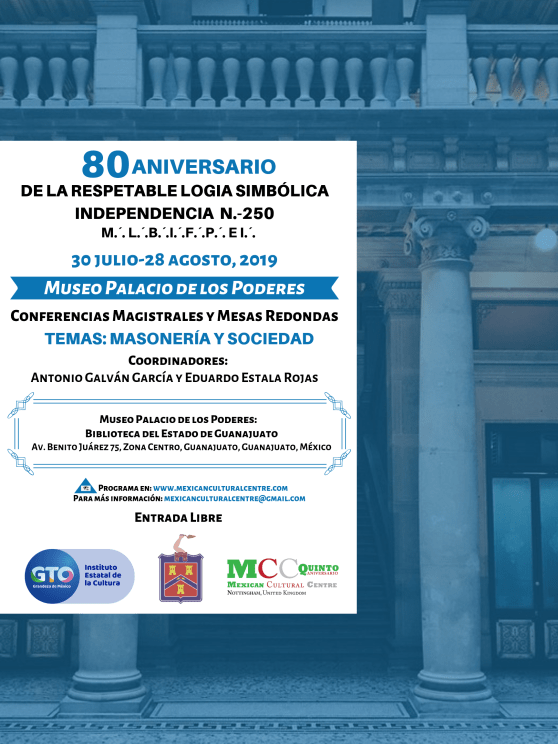
Para descargar el programa un clic aquí.


By César Octavio Moreno Zayas
The famous soprano Luisa Tetrazzini, one of the first big opera stars to put her voice on a record, visited México at the beginning of the 20th century. Her tour comprised the capital and many other cities, all the presentations had huge success; she was even labeled as the Florentine Nightingale and the New Patti. Her tour also included the city of Morelia, capital of the state of Michoacán, la Tetrazzini wrote in her biography, My life song (1922), that “the Town of Morelia is a veritable paradise” because she was fully and positively shocked by the beauty of the baroque city.

Mexico’s Premiere Summer Opera Festival. For more information: https://www.isofomorelia.com/
The repertoire selected for her exploration in Michoacan’s lands had the famous Gaetano Donizetti’s Lucia di Lammermoor, Giuseppe Verdi’s masterwork La Traviata, Il Barbiere di Siviglia by Gioachino Rossini, and the, by them, popular title of Dinorah, composed by Giacomo Meyerbeer. Everything was nicely settled, but order and a complain came from religious groups of the city, which said that just Lucia was possible to be performed. La Tetrazzini argued extensively, and after long dialogues, enriched with her wit, the operas were performed. Nevertheless, some modifications were needed. For example, Dinorah, a story of passion and love about a girl who became mad because her fiancé disappeared the day of her wedding, turned to be called The Pardon of the Virgin and promoted it as a Biblical opera.
Fortunately, the cautious attitude towards opera that the famous singer found has changed into a much more friendly interest. A good example of the positive diversion is the now successful International Summer Opera Festival of Morelia (ISOFOM). It is an educational, artistic program, which aims to provide high-quality artistic events, but also to be an educational project that helps emerging artists to improve, as well as to launch their careers internationally. Recently, I had the opportunity to talk with Juan del Bosco, General Executive Director and founder of the festival. He provided me with interesting information about the opera-doing of the festival. The project, which is part of a larger and ambitious one, aims to establish on the regular basis an educational program that enables international, as well as Mexican singers to learn different aspects of opera-doing at the highest standards, such as masterclasses with singers, language coaching and acting skills. Young artists have the opportunity to get a plus in their career via learning from international professionals.
The ISOFOM’s activities integrate local artists, e.g. its orchestra is formed by local musicians of Morelia, as well as an international team. The Faculty, as it is called the educational program, integrates this year: Felipe Tristan (Music Director and Conductor), A. Scott Parry (Stage Director), Ugo Mahieux (Repetiteur), Elsa Queron (Head of Coaching), Antonio Santoyo (Coach and Accompanist), Michel Johnson and Kristen Chambers (MasterClass Presenters). The program also includes a gala, which this year took place at the historic building of the Clavijero Cultural Centre.
A full orchestra opera performance of Verdi’s Falstaff is one of the gems of the current festival. Falstaff, as I commented to Juan del Bosco, is not an easy title. Verdi’s last opera requires a large cast, who must work always at the top, plus a good orchestra and an impressive chorus. But, the executive director replied, and calmed my nerves, by replying that titles are carefully handpicked according to the characteristics and aims. The selection is made by the committee of the Festival. Then, honestly, I am curious about the outcome, which, looks to be promising, particularly I am keen to explore the concrete results of the educational program because the participants of the Faculty are involved in the semi-staged production of Falstaff.
The Festival has extended its ties to Monterrey city, where some events will take place next year. Moreover, it has already activities in Germany, which eventually guarantee an international presence and impact. The self-financed festival, which is a big achievement, has also managed to be part of the cultural activity of Morelia, and its efforts may consolidate the regular high-quality opera activity in Mexico, which is something that the country requires, and maybe, modifying Tetrazzini’s words “Morelia might be a veritable operatic paradise.”
César O. Moreno Zayas is a Ph.D. Candidate in Music at The University of Nottingham, United Kingdom. He is carrying out a research on opera audiences and management. His main research areas of interests are opera history, sociology of opera, and opera production. He has recently collaborated with publications for Opera Wire, Mexican Cultural Centre and Las Nueve Musas Magazine. The production of opera is another important part in his expertise, he has produced in 2015 the premiered of the opera Eugenia by the Mexican composer Armando Ortega. Now he is working for a project of Acis, Galatea and Polyphemus by Handel for the City of Orizaba. He has presented papers at specialized congresses and institutions on music, media studies and opera at UNAM, University of Copenhagen, CENIDIM, University of Veracruz, Sibelius Academy, Lund University, and at the University of Nottingham. He is currently collaborating on a research project on independent theatre at the Mora Institute in Mexico City, and he co-coordinate at 17, Critical Studies Institute the Certificate on Contemporary Views in Semiotics: Art, Society, and Digitality.

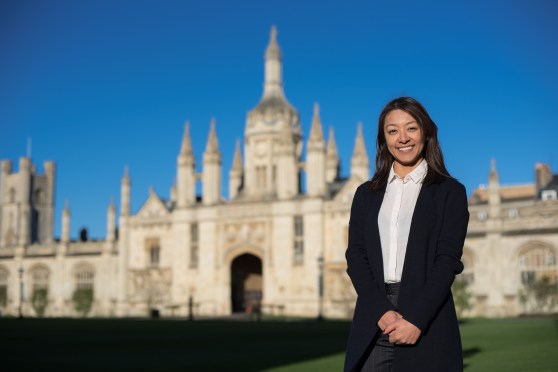
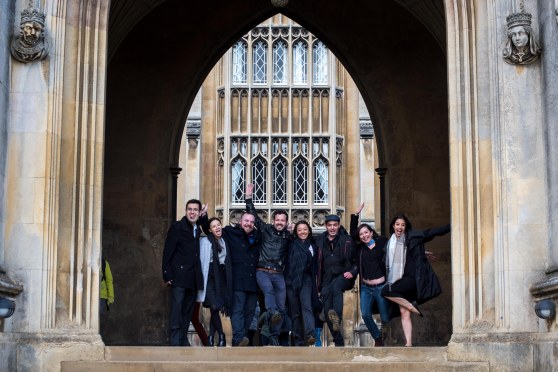
Jessica A. Fernández de Lara Harada, líder del Comité Organizador del XVII Symposium of Mexican Studies and Students in the UK, 2019. Además es la presidenta de la Cambridge University Mexican Society y la Cultural Officer de la Society of Mexican Students in the United Kingdom. Fotografía: Alfonso Hernández Ríos (Vice Presidente de la Cambridge University Mexican Society, 2019).
Por Eduardo Estala Rojas
Jessica Fernández de Lara Harada, lidera el Comité Organizador del XVII Symposium of Mexican Studies and Students in the UK, que se realizará del 26 al 28 de junio de 2019 en la Universidad de Cambridge. Además es la presidenta de la Cambridge University Mexican Society y la Cultural Officer de la Society of Mexican Students in the United Kingdom, ambas sociedades son las anfitrionas del simposio este año. Como presidenta del Comité Organizador, tiene a su cargo la dirección del Comité, la coordinación de los Sub-Comités, y la cooperación con autoridades para lograr que el simposio se lleve a cabo exitosamente. El tema de esta edición es “Challenging ideas about Mexico and the World”.
México es el enfoque principal del simposio y el motivo más importante que reúne a todos sus organizadores, colaboradores y participantes. El simposio es una plataforma que busca reunir a mexicanos y personas interesadas en México de todo el mundo, con el fin de crear intercambios intelectuales, académicos, culturales, científicos y colaborativos para el bienestar, desarrollo y prosperidad de México.
“Challenging Ideas about Mexico and the World”
“Desde mediados de 2017, se realizaron varios acercamientos con miembros de la comunidad mexicana en Cambridge para invitarlos a colaborar en este proyecto. Nuestra primera reunión formal como Comité fue convocada el 18 de enero de 2018 en Emmanuel College, Cambridge. Durante esta reunión, preparamos una propuesta sólida que presentamos ante la Asamblea General de la Society of Mexican Students in the UK (MexSoc UK), en la edición anterior del simposio en Southampton que se realizó del 11 al 13 de julio de 2018. En dicha Asamblea, nuestra propuesta resultó ganadora. Desde entonces reunimos a personas, ideas y esfuerzos para realizar el simposio, el cual se ha concretado a paso constante”, comentó Jessica Fernández de Lara Harada, candidata a doctora por la Universidad de Cambridge en el Centre of Latin American Studies.

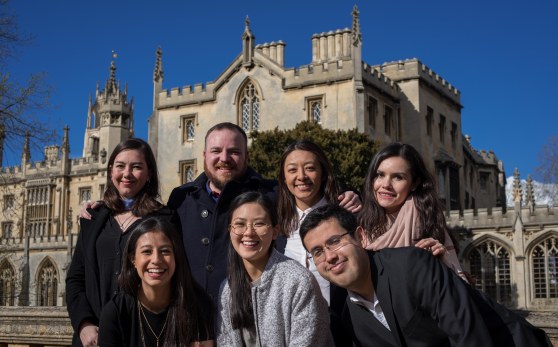
Comité Organizador del XVII Symposium of Mexican Studies and Students in the UK, 2019. De izquierda a derecha: parte superior: Cristina Acasuso, Alan Parker, Jessica A. Fernández de Lara Harada, Aracely Castillo Venzor. Parte inferior: Ana Laura Trigo Clapes, Masami Ando Kuri y Fernando León Cazares. Fotografía: Alfonso Hernández Ríos (Vice Presidente de la Cambridge University Mexican Society, 2019).
El Comité Organizador está integrado por 23 miembros y se compone de 12 Sub-Comités, los cuales tienen a su cargo la planeación, organización y ejecución de áreas específicas del simposio. “Los Sub-Comités están encabezados por un coordinador de cada área, y los integran Paola Velasco Herrejón y Christian Esparza (Students Affairs), Aracely Castillo Venzor, Fernando León Cazares y Ana Rubio Jiménez (Keynote Speakers), Ana Trigo Clapes, Luis Welbanks y Cristina Acasuso Rivero (Logistics), Brenda Torres Montoya (Communications), Laura Solís Gómez (Budget), Masami Ando Kuri y Eddie Cano Gámez (Socials), Alejandro Guizar Coutiño y Claudia Hernández Armenta (Website), David Harada (Graphic Design), Sarah Abel (Proofreading), Filo de la Llata (Networking), Estelle Praet, Karla Cervantes Barrón y Roberto Zedillo Ortega (Art Exhibition); y Alfonso Hernández Ríos, Sofía Sánchez Velasco y Jessica Fernández de Lara Harada (Liaison)”, indicó el Comité Organizador.
La edición del simposio en Cambridge abarca siete ejes temáticos con los que se espera representar todas las disciplinas de investigación, conocimiento y práctica de los participantes. Estos ejes temáticos incluyen: Ciencias Físicas, Ciencias Biológicas, Ingeniería y Tecnología, Ciencias Sociales, Artes y Humanidades, Energía y Sustentabilidad, y Estudios Mexicanos.
“El Symposium of Mexican Studies and Students in the UK, se ha realizado de manera regular durante dieciséis años y actualmente es el evento académico más importante en el contexto británico sobre temas relacionados con México. Así el simposio busca mantener la posición que ha consolidado a lo largo de estos años como un foro único de aprendizaje, colaboración e intercambio entre expertos, académicos, estudiantes y todas aquellas personas, de todas las nacionalidades, interesadas en nuestro país”, señaló Jessica Fernández de Lara Harada.
Historia y reconocimiento oficial en el Reino Unido
La Sociedad de Estudiantes Mexicanos en el Reino Unido (MexSoc UK, por sus siglas en inglés) se fundó el 1º de septiembre de 2003, en la London School of Economics (LSE), con la presencia del escritor y diplomático mexicano Carlos Fuentes (1928-2012), quien fungió como invitado especial y se convirtió en el padrino de la sociedad. Los presidentes fundadores de la MexSoc UK fueron: Eric Manuel Rosales Peña Alfaro, presidente MexSoc Universidad de Essex; José Bernardo Rosas Fernández, presidente MexSoc Universidad de Cambridge; Salvador Elías Venegas Andraca, presidente MexSoc Universidad de Oxford; Jorge Axel Domínguez López, presidente MexSoc Universidad de Southampton; Rodrigo Aguilar Benignos, presidente MexSoc London School of Economics. Actualmente, la MexSoc UK está presente en 20 universidades y es una Company House (número de registro 8752516), este concepto oficial la convirtió el 29 de octubre de 2013, como el primer organismo mexicano de su tipo en el Reino Unido, con todas las responsabilidades y prerrogativas que provee la ley británica.

Presidentes fundadores de la MexSoc UK, London School of Economics (LSE), Reino Unido (2003). De izquierda a derecha: Eric Manuel Rosales Peña Alfaro, presidente MexSoc Universidad de Essex; José Bernardo Rosas Fernández, presidente MexSoc Universidad de Cambridge; Salvador Elías Venegas Andraca, presidente MexSoc Universidad de Oxford; Jorge Axel Domínguez López, presidente MexSoc Universidad de Southampton; Rodrigo Aguilar Benignos, presidente MexSoc London School of Economics. Fotografía: Salvador Elías Venegas Andraca.
Conferencias magistrales en el 2019
Cada año, el simposio es organizado por la MexSoc UK y diferentes universidades del Reino Unido, con el apoyo del CONACyT y de la Embajada de México en el Reino Unido. En el 2019, este simposio multidisciplinario en la Universidad de Cambridge, espera reunir a más de doscientos académicos, investigadores y estudiantes internacionales, en un evento de tres días, en donde puedan exponer y discutir sus trabajos relacionados con México en sus respectivos campos.
Los conferencistas magistrales para esta edición son: 1. Physical Sciences: Dr. Pablo Rendón Garrido (UNAM, México) 2. Biological Sciences: Prof. Alejandro Madrigal (University College London, UK) 3. Social Sciences: Mtra. Brenda G. Hernández Ramírez (Comisión Federal de Competencia Económica, México) 4. Engineering and Technology: Pdta. Elena Rodríguez Falcón (New Model in Technology and Engineering, UK) 5. Honourable speaker: Dra. Mónica Moreno Figueroa (University of Cambridge, UK), y 6. Arts and Humanities: TBC (acrónimo del inglés “to be confirmed”, que significa: “por confirmar”).
“Con esto el simposio busca contribuir y crear una plataforma a través de la cual se generen vínculos, se difundan conocimientos y se fomenten colaboraciones, mediante las interacciones entre estudiantes, académicos e instituciones, durante los tres días del simposio”, agregó el Comité Organizador.
Organizadores y patrocinadores en el 2019
El Reino Unido se ha convertido en uno de los dos principales destinos para estudiantes mexicanos en el extranjero, y es un puente importante para impulsar mayores intercambios económicos, culturales y educativos a nivel internacional. “El trabajo de la Society of Mexican Students in the UK (MexSoc UK), la Cambridge University Mexican Society, y del Comité Organizador del XVII Symposium of Mexican Studies and Students in the UK, es relevante ya que contribuye a estrechar los lazos entre México y el Reino Unido, así como la presencia mexicana en el mundo”, expresó Jessica Fernández de Lara Harada.

Comité Organizador del XVII Symposium of Mexican Studies and Students in the UK, 2019. De izquierda a derecha: Fernando León Cazares, Masami Ando Kuri, Alan Parker, Alfonso Hernández Ríos, Jessica A. Fernández de Lara Harada, Filo de la Llata, Cristina Acasuso y Ana Laura Trigo Clapes. Fotografía: Alfonso Hernández Ríos (Vice Presidente de la Cambridge University Mexican Society, 2019).
Reconociendo la importancia del simposio en la difusión de los nuevos investigadores y sus aportaciones, “se ha trabajado de manera conjunta con la Universidad de Cambridge, y en particular con la Cambridge University Mexican Society, el Centre of Latin American Studies de la Universidad de Cambridge, Gates Cambridge, Emmanuel College, Universidad de Cambridge, y Policy Links, Universidad de Cambridge, para llevar a cabo el XVII Symposium of Mexican Studies and Students in the UK. De manera significativa, contamos con el apoyo de la Embajada de México en el Reino Unido, el CONACyT, la Senior Treasurer de la Cambridge University Mexican Society, Dra. Mónica Moreno Figueroa, el Mexican Cultural Centre (MCC), la Cámara de Comercio de México en el Reino Unido, y Nanna México”, indicó el Comité Organizador.
Para más información del simposio:
Websites: http://www.symposiummx.com/ http://www.cambridgemexsoc.org http://www.mexsoc.org.uk/Facebook page: symposiummx2019 Twitter: @MX_Symposium Instagram: symposium.mx Gmail: symposiummx2019@gmail.com
Eduardo Estala Rojas es el director fundador del Mexican Cultural Centre (MCC), Reino Unido. Correo electrónico: mexicanculturalcentre@gmail.com


Por Eduardo Estala Rojas
El 1º de junio de 2019 se llevará a cabo la primera edición del «Latin American Art and Cultural Research Symposium in the UK: Art + Identity», en el Latin American Centre de la Universidad de Oxford, Reino Unido. El simposio lo están organizando la Oxford Mexican Society, Oxford Latin American Society, Iberoamerican Society de la Royal Central School of Speech and Drama, con el apoyo del Mexican Cultural Centre (MCC), Reino Unido.
La planeación del simposio comenzó a partir de 2018 por cuatro becarios del FONCA-CONACyT, México. “Platicamos sobre la necesidad de una red de trabajo en el Reino Unido, como resultado de esta charla comenzamos a unir esfuerzos para organizar el Simposio de Estudios de Arte Mexicano en el King´s College London, en junio del año pasado. Este año, decidimos dar un paso más grande y abrirlo al Arte Latinoamericano, por ende integrando al equipo organizador y comité de selección a estudiantes latinos y así cubrir mejor las necesidades de los investigadores, además de diversificar el contenido de las propuestas y enriquecer el evento ampliamente”, indicó el Comité Organizador.
Actualmente el Comité Organizador está integrado por cinco estudiantes de posgrado: Jorge Aguilar Rojo del Central Saint Martins, Rocío Gómez de la Universidad de Oxford, Miroslava González de la Universidad de Roehampton, Jimena Mancilla, María Fernanda Cuervo y Sebastián Cruz de la Royal Central School of Speech and Drama. El evento contará con la participación de representantes de México, Chile, Costa Rica, Colombia, Uruguay, Bolivia, Perú, Ecuador y Venezuela.
Este simposio tiene diversidad en las áreas de estudio y disciplinas de los participantes: danza, música, estudios culturales y literatura. Según el Comité Organizador: “el simposio busca la creación de una red de trabajo, compartir estudios e investigaciones, proporcionar una nueva plataforma de apertura y difusión del Arte Latinoamericano en el Reino Unido, creando oportunidades de colaboración y desarrollo entre los participantes y oyentes, universidades y organizaciones involucradas en el evento académico”.
El organizar simposios con temáticas latinoamericanas tienen relevancia porque a comparación de otras nacionalidades extranjeras en el Reino Unido, «los latinos representamos una cantidad menor, creemos que es importante mantenernos unidos y fortalecer nuestras redes de trabajo y colaboración en este país. Hay más investigadores de Arte Latinoamericano de los que pensamos y conectar es importante, así como crear más plataformas para temas Latinoamericanos en el ámbito académico en el Reino Unido, seguir difundiendo y creando puentes entre el Reino Unido y Latinoamérica”, agregó el Comité Organizador.
Eduardo Estala Rojas es el director fundador del Mexican Cultural Centre (MCC), Reino Unido. Correo electrónico: mexicanculturalcentre@gmail.com


By César Octavio Moreno Zayas
500 years ago, on April 22 Hernan Cortez arrived to Veracruz to start what is called the conquest of Mexico. Centuries have passed and still, we don’t see a 100% serenity in the environment of all the parts.
For example, recently the president of Mexico, Andrés Manuel López Obrador, has sent, via the Ministry of Foreign Affairs of Mexico a letter to the government of Spain, particularly the King. He asked for an official apology for the issues caused by the conquest. The letter and the rejection of it by the monarch have caused clashes and reactions on both sides of the Atlantic Ocean. Intellectuals of any type discussed and argued the pros and cons of that diplomatic movement. Some have agreed about the need for an apology, while others voted for a peaceful silence for the best of the mutual respect. The upheaval even moved scholars to dig into the archives, where they spotted a peace treaty between Mexico and Spain signed back in 1836.

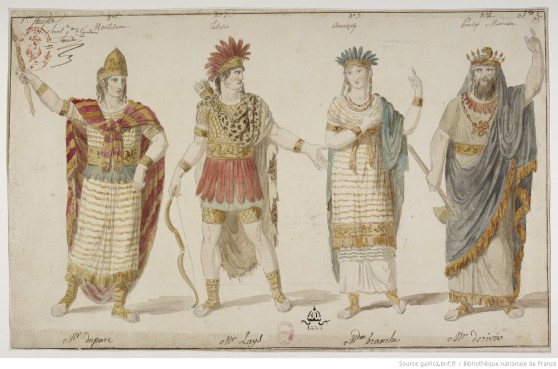
«Fernand Cortez ou la conquête du Mexique : sept pl. de costumes.» Source https://gallica.bnf.fr / Bibliothèque nationale de France.
The turmoil, diplomatic and on the media, is not new and it shows that there is still too much to work on. Some weeks ago the Mexican streaming platform Claro Video has released the documentary Malintzin; Marina, Malinche o Malintzin was the interpreter of Hernan Cortés. Via Marina, the Spaniard conquistador was able to understand and communicate his desires and plans to his allies and enemies in central Mexico. Marina is, then, considered as a traitor by some people, even the word “malinchista,” is often heard among Mexicans, who refer to the person who prefers foreign (people or goods) to Mexican ones. But, this story has another interpretation, which is highlighted in the documentary, that she did not betray her people because the Mexica people were not her people; they were in fact her enemies. In consequence, she acted according to her beliefs for the best of her community. The debate seems, then, to lie on the alliance despite inner conflicts with other cultures or segregation because of those conflicts.
Marina, Cortez, and Emperor Moctezuma are of course very polemic, and their story, as it has been said, had inspired different reactions. Different media and artistic genres have approached the subject and opera is one of them. Opera has experience at putting on a large scale stage the most interesting representation of social, political or moral issues. For example, the love adventures of Nero depicted in L’Incoronazione di Poppea by Monteverdi, the class distinctions that appear in Mozart’s Le Nozze di Figaro, the famous love story of a courtesan in La Traviata by Verdi, public opinion against one man in the dramatic Peter Grimes composed by Britten, or even a terroristic attack as it appears in The Death of Klinghoffer by Williams. Then, opera in more than 400 years has had the time to describe stories, conflicts, traumas, achievements, as well as real, ideal, sad or funny stories. The Conquest of Mexico and its characters, of course, have been in the opera as early as 1733 when Vivaldi composed his Moctezuma.

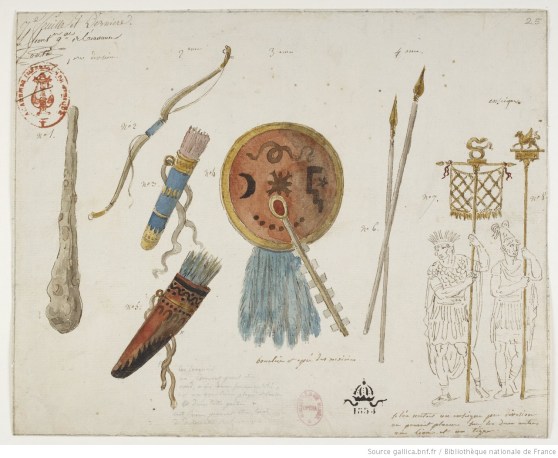
«Fernand Cortez ou la conquête du Mexique : sept pl. de costumes.» Source https://gallica.bnf.fr / Bibliothèque nationale de France.
The subject of the conquest has appeared several times through the history of opera, and one good question is: how to depict that cultural clash in opera? Because, it is not easy to display a conflict like this on a musical drama. I will try to approach to this matter by mentioning two brief examples: Graun’s Montezuma and Spontini’s Fernand Cortez.
Carl Heinrich Graun premiered his Montezuma in Berlin in 1755. The libretto was written in French by the same King of Prussia, Frederik II the Great; the text was then translated into Italian by Giampietro Tagliazucchi to be sung in the usual language of the opera in those years. Ramón Jauve-Martín considers that this work does not present the conquest as a triumph of Europe, moreover, it criticizes it and takes side with the Aztec Empire, particularly it reprimands catholic southern Europe. Thus, Frederik and Graun’s approach seems to highlight the differences between Catholic and protestants, and as Marina, they prefer to follow the attraction of the unknown culture of the Americas, rather than accept the well-known political problem in Europe 53 years after Graun’s work, another opera appeared to display a spectacle that will shake the Spanish Empire.
Fernand Cortez, ou La Conquête du Mexique composed by Gaspare Spontini, with a libretto written in French by Etienne de Jouy and Joseph-Alphonse Esménard. The opera tells a story of the conquest, which includes a love story between a daughter of the emperor Montezuma and Cortez. The work finishes with the rendition of the emperor, a peace agreement and also the Aztec monarch gives the hand of his daughter to Cortez. The work, as explained by Sarah Hibberd, reflects the political context of its premiere. It was commissioned by Napoleon I as propaganda after his invasion to Spain in 1808. The conquerors were conquered and the kings were overthrown in both cases. Then, Spontini’s conquest display not just a religious or political conflict in Europe, rather it uses a story of the past to propose or anticipate a future. The problem for Spontini and Napoleon is that this future is not going to happen, because the invasion did not increase the territories, in fact, it encouraged the separation and future creation of new countries, like Mexico.
The conquest of Mexico in conclusion cannot be labeled solely as an entertainment, but it is a complex sign made by different readings. Some of those of those readings are still present, for example in the discussions of the letter to the king. However, let’s move to Madrid, maybe we can find some ideas for a truce of this half-millennium conflict. In 2013 the Teatro Real presented a new production of Wolfgang Rihms’ Die Eroberung von Mexiko. The opera, premiered in Hamburg in 1992, has a libretto written by the composer, based on Antonin Artaud, it also includes works by Octavio Paz. The finale of this work is different, and it walks in another direction. In words of Gerard Mortier, Rihm’s opera shows that cultures must understand each other, and their encounter must conclude in harmony, not in blood. Then, we may listen to the opera, is an old genre, it has experience, and it has seen many things of the world. We might learn something from it, and find a peaceful resolution.
César O. Moreno Zayas is a Ph.D. Candidate in Music at The University of Nottingham, United Kingdom. He is carrying out a research on opera audiences and management. His main research areas of interests are opera history, sociology of opera, and opera production. He has recently collaborated with publications for Opera Wire, Mexican Cultural Centre and Las Nueve Musas Magazine. The production of opera is another important part in his expertise, he has produced in 2015 the premiered of the opera Eugenia by the Mexican composer Armando Ortega. Now he is working for a project of Acis, Galatea and Polyphemus by Handel for the City of Orizaba. He has presented papers at specialized congresses and institutions on music, media studies and opera at UNAM, University of Copenhagen, CENIDIM, University of Veracruz, Sibelius Academy, Lund University, and at the University of Nottingham. He is currently collaborating on a research project on independent theatre at the Mora Institute in Mexico City, and he co-coordinate at 17, Critical Studies Institute the Certificate on Contemporary Views in Semiotics: Art, Society, and Digitality.

El sábado 30 de marzo de 2019 se presentará la obra teatral “Ceviche en Pittsburgh” del escritor peruano José Castro Urioste en el Instituto Cervantes (31 W. Ohio, Chicago, Illinois, Estados Unidos de América) a las 19:00 horas. “Ceviche en Pittsburgh” es producida por el grupo de teatro “El Tecolote”, y dirigida por el mexicano Roma Díaz, quien es miembro del Consejo Consultivo del Mexican Cultural Centre (MCC), Reino Unido.

Esta presentación es un homenaje a los veinticinco años del estreno de “Ceviche en Pittsburgh”, del escritor peruano José Castro Urioste. Fotografía: Rafael Ortiz-Calderón.
Previamente, a las 18:00 horas, se realizará una recepción auspiciada por el Consulado de Perú de Chicago. Esta presentación es un homenaje a los veinticinco años del estreno de “Ceviche en Pittsburgh”, la cual se ha producido anteriormente en distintas ciudades norteamericanas como Pittsburgh, Los Ángeles, Dallas y Chicago.
“Ceviche en Pittsburgh” cuenta la historia entre dos hermanos: Toño, el menor, quien radica en los Estados Unidos y realiza estudios doctorales en Historia Latinoamericana; y Carlos, ocho años mayor, quien vive en Lima, Perú, y trabaja en la compañía del padre. Carlos visita sorpresivamente a su hermano en Pittsburgh. Preparan un ceviche de fin de semana y allí surgen los conflictos entre dos proyectos de vida: el de aquel que busca realizarse en los Estados Unidos; y el de aquel que ha preferido quedarse en su país de origen.

«Ceviche en Pittsburgh» es producida por el grupo de teatro «El Tecolote», y dirigida por el mexicano Roma Díaz. Fotografía: Rafael Ortiz-Calderón.
“Ceviche en Pittsburgh”es producida por el grupo de teatro de Chicago “El Tecolote” , y dirigida por Roma Díaz (México). El elenco está compuesto por Luiza Franco (Colombia), Rafael Manzo (México) y Sergio Silva (México). La escenografía está a cargo de la artista plástica Esperanza Gama (México). La entrada general es $20 y $10 dólares estadunidenses para estudiantes y adultos mayores, así como para grupos de un mínimo de cinco personas.