

Programa: XXI EIDL y VIII SIILA 2018

La Academia Mexicana de Lógica A.C. (AML) es la institución nacional que se encarga de promover la investigación, la difusión y enseñanza de la lógica en nuestro país. Dos razones principales para su fundación fueron: la importancia que tiene la enseñanza de la lógica para la formación de mejores profesionistas y ciudadanos, y la importancia de que una materia tan abstracta y formal sea didáctica al enseñarse.
En México no hay formación docente que aborde didácticas especializadas en el área de la lógica y sus campos de formación afines. En 1996, un grupo de académicos de distintas universidades del país crearon el Taller de Didáctica de la Lógica (TDL) y en 1998 el Encuentro Internacional de Didáctica de la Lógica (EIDL). Para 2004 se desarrolló un nuevo espacio para difundir la lógica en los jóvenes: la Olimpiada Internacional de Lógica. Y en el año 2011 con objeto de fortalecer la investigación en lógica, se da inicio al Simposio Internacional de Investigación en Lógica y Argumentación; cada una de estos eventos académicos forman parte de las actividades regulares de la Academia Mexicana de Lógica.
En el EIDL han participado figuras internacionales como la Dra. María José Frápolli (University College London, Reino Unido/ Universidad de Granada, España), Dra. Susan Haack (University of Miami, Estados Unidos), Dr. Enrique Alonso (Universidad Autónoma de Madrid, España), Dr. Gustavo Arroyo (Universidad Libre de Berlín, Alemania/Universidad Nacional de General Sarmiento, Argentina), Dr. Leo Groarke (Trent University, Canadá), Dr. Raymundo Morado Estrada (UNAM, México), Dr. Alejandro Herrera (UNAM, México), Dr. Axel Barceló (UNAM, México), Dr. Claudio Conforti (UCA/UNSTA, Argentina), Mtro. Ariel Campirán (UV, México), Dr. José Alfredo Amor (UNAM, México), Dr. John Corcoran (University at Buffalo, Estados Unidos), Dr. Hubert Marraud (Universidad Autónoma de Madrid, España), Dr. Luis Vega Reñón (UNED, España), Dra. Itala D’Ottaviano (Universidad de Campinas, Brasil), Dra. Corina Yoris Villasana (UAB, Venezuela), Dra. Atocha Aliseda Llera (UNAM, Mexico), Dr. Jesús Jasso Méndez (UACM/UNAM, México), Dr. Juan José Rosales (Venezuela), Frans Van Eemeren (U. Ámsterdam, Holanda), Dra. Gladys Palau (Universidad de la Plata/UBA, Argentina), Dr. Diógenes Rosales (PUCP, Perú), Mathieu Beirlaen (Ghent University, Bélgica), Dr. Adelino Cattani (Universidad de Padua, Italia), Dra. Mara Manzano (Universidad de Salamanca, España) entre otros investigadores reconocidos en México y el mundo.
Este año el encuentro es organizado en colaboración con la Universidad Internacional Jefferson, The Mexican Cultural Centre (MCC-Reino Unido), Instituto de Ciencia, Tecnología e Innovación, Centro de Investigación y Enseñanza de las Matemáticas, Escuela Normal Urbana Federal J. Jesús Flores, Multiversidad Educativa, Universidad CEUMA y el Programa de Fortalecimiento de la Calidad Educativa de la Secretaria de Educación Pública. La sede será la Universidad Internacional Jefferson y se espera contar con la participación de más de 100 investigadores y docentes de México y América Latina.
Los tópicos de investigación en esta edición son: Didáctica de la lógica, Lógica formal e informal, Pensamiento crítico y Argumentación, Razonamiento y Computabilidad, Filosofía de la lógica y Metodología de la investigación, en presentación plenaria de mesas de trabajo. Para mayores informes y envío de trabajos académicos puede escribir a coordinacion.eidl@gmail.com
El EIDL y SIILA son los espacios de difusión de la lógica y su investigación más importante de habla hispana.
Programa completo, clic aquí.
Día Mundial de la Filosofía, UNESCO, 2018

Día Nacional del Libro, México

Biblioteca Digital TELMEX Guanajuato, México

9° Tour Eurochannel de Cortometrajes

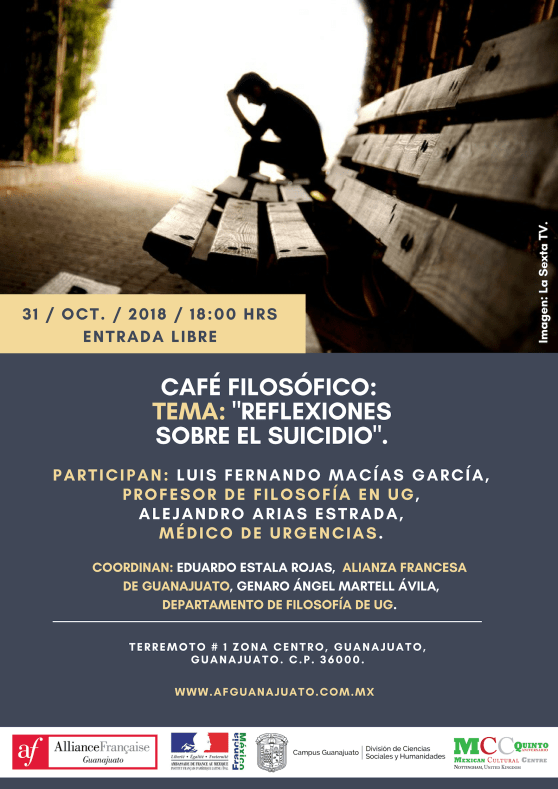
Café Filosófico: «Reflexiones sobre el suicidio»
«Construction Déconstruction» de Liliana Pérez
Par Mr. Antonio Rizo Ramírez
UNAM / Académie San Carlos
Mexique, octobre 2018
 «Déconstruction» n’existe ni dans le schéma du temps mécanique, ni dans l’urgence artificielle des angoisses contemporaines. «Déconstruction» signifie, selon Jacques Derrida, dévoiler les choses à travers les expériences inscrites, dans les surabondances du temps, ainsi le temps équivaut-il à quelque chose de vivant et qui fait vivre.
«Construction» est un retour vers les choses transformées par la triade: expérience-temps, chose-temps, individu-temps, jeu subtil car la création –pour un artiste- a de sérieuses conséquences. Les créateurs émettent des réserves sur ce qu’ils présentent au monde parce que c’est inédit, car même quand leurs références artistiques viennent d’un passé supposé, il est recréé dans le présent, sous l’étude des artistes référents. Les interprétations des choses vivantes en sont le résultat.
Le temps est le facteur commun qui le décante en transformant tout. La création picturale, à partir de Construction Déconstruction, est conforme et conditionnelle au présent constant contemporain ; elle fait référence à la peinture des objets mais aussi: avec et à partir des objets. Elle opère des changements de matière picturale, compris en tant que choses insérées sur le plan pictural et qui sont en même temps une matière picturale essentielle, d’une compréhension bigarrée et créative, parfois en tant que signes, parfois en tant que symboles.
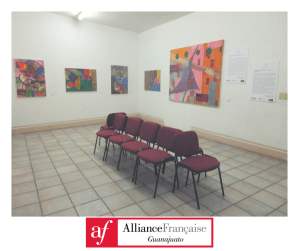 L’action picturale -pour l’artiste Liliana Pérez- ne concerne que son instinct de peindre. La philosophie et les matériaux extra-picturaux sont les pionniers utilisés dans sa vocation expressive, éléments qui rendent possibles la diversité créative et la diversité dans son interprétation des choses à sa portée.
Liliana ne fait pas que nous montrer ce qu’elle pense d’une culture volatile post-moderne ; elle nous rend complices de ses objets, ses textures, les couleurs et les compositions. Mais il est certain que ce qui est fondamentalement important, c’est qu’elle nous emporte dans son intimité artistique.
 Terremoto # 1 Zona Centro, Guanajuato, Guanajuato, México. C.P. 36000. Teléfono: 52-473-7321326. Correo electrónico: afguanajuato@gmail.com
Presentación editorial «Pentimento” de Daniel Silva

Luciérnaga: exploring the hyperreality and hyper-myth
By César Octavio Moreno Zayas
PhD Candidate for The University of Nottingham, United Kingdom
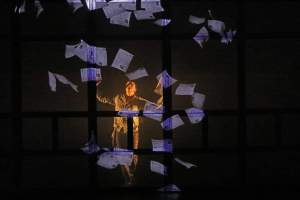
Photograph: Silvia Peláez.
Last Thursday, October 11, I went to the second performance of Luciérnaga (Firefly) the last opera composed by Gabriela Ortiz with a libretto written by Silvia Peláez. It was a very interesting experience musically, vocally as well as visually. The performance took place at the Sala Miguel Covarrubias at the National Autonomous University (UNAM). This one and a half hour long opera tells the story of Alcira Soust Scaffo, an Uruguayan poet, who locked herself at the male toilet of the Tower of Humanities at UNAM, during a military intervention to the university on September 18, 1968.
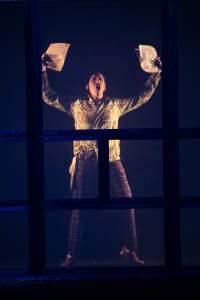
Photograph: Silvia Peláez.
1968 was a year of different social movements around the world. In Mexico, there was also a movement that evolved into a large-scale conflict between different groups (students and the state). Books have been written exploring the different reasons that have led to such outcomes. Therefore, it is a sensitive subject to talk about, and to create an opera based on this was not an easy job. Opera and politics or social issues have been always present through the whole history of the genre, but its forms to show it was not always so direct. The 20th and 21st Century have seen the premieres of operas dealing with very specific and contemporary concerns, for example, John Adam’s Doctor Atomic or The Death of Klinghoffer, Kurt Weill’s Rise and Fall of the City of Mahagonny, or Mark-Anthony Turnage’s Greek. As for me, Luciérnaga was a clever choice among the different options to talk about the movement of 68, which now it is its 50th anniversary.
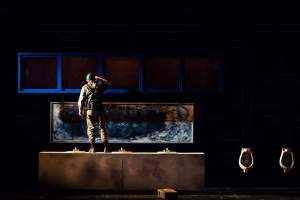
The librettist has created a good text for a soprano and a male actor. The work narrates a claustrophobic environment, and we see how Alcira, sung by Cecilia Eguiarte, tells what is happening outside the building but also things that happen in her head. She struggles with real facts and with her mind. The actor José Juan Sánchez appears sometimes as a soldier (a real one), others as a mere character of Alcira’s mind, such as a dinosaur (common visual representation of the leading party of that time; PRI).
Photograph: Silvia Peláez.
The music of Gabriela Ortiz was very descriptive for such plot full of uprising emotions and inner feelings. It was a turmoil very well depicted by percussions and winds, sometimes nice and lovely, others aggressive and chaotic, but always on the track of the plot. The soprano Cecilia Eguiarte sang an interesting and convincing Alcira, dealing always well with the defying score and acting adequately. The actor José Juan Sánchez did a good job performing the characters. The orchestra, Onix Ensemble, was conducted by Ludwig Carrasco, very well conducted, always firm and steady.

Photograph: Silvia Peláez.
The production was directed by David Attie. It was a very good work with projections exploring different elements of Alcira’s mind, including the reptile traits. But, also it consisted of some flexible panels resembling the windows of the building, behind those panels we could see the toilets services. The use of all the material was very good, giving always a reason for each element on the stage. It was for me interesting the separation of the singing part and the acting part because it reminds me the distinction that Adorno does between audience who wish to sing, but cannot, and the singers who are able to express the desires of the audience. Considering this perspective Alcira stands for a poet thought that moves in the world of ideas and ideals. The work in the whole was very good, maybe some elements might be extra, as for my taste, but that it is a just personal choice. I highly recommend this work and I am hoping to see it again because it should have had more than three performances.
 Mexican Cultural Centre, United Kingdom