Obra plástica y visual de la mexicana Adriana Puente

Por Ricardo Ariza

En la obra plástica y visual de Adriana Puente la superficie en blanco es el silencio primigenio; allí la impronta del pincel, la tinta, la mano y la mujer que las dirige, abrirán una vía regia al inconsciente, al río de lenguajes de lo que no se puede conocer a través de la razón, aquello que es memoria orgánica.


Adriana Puente. Fotografía: Maricela Figueroa Zamilpa.

Adriana Puente. Fotografía: Maricela Figueroa.

Cada pincelada es irrenunciable en el camino del propio descubrimiento: ataque de frente o arrastre, frotado o de ritmo sincopado, manchas con o sin contorno, concentrado o diluido, firme o tembloroso, el ejercicio plástico del accidente controlado develará el vacío como redondo espacio de posibilidades.

El zen es una escuela del budismo mahāyāna y tanto como el «confucianismo» de la China imperial de hace dos mil años y el «taoísmo», son filosofías que buscan la armonía del ser con el universo, por lo cual observan profundas meditaciones con la finalidad de «vaciar» la mente, para que una vez logrado, pueda llenarse con el conocimiento verdadero. Así a grandes rasgos, porque no hay forma de definir esa experiencia en palabras.

La pintura es una de las grandezas de estas culturas. Sin embargo, no podría definir una escuela artística como arte zen. El zen es una filosofía que floreció en el pasado de Japón; la pintura de agua y tinta es un medio en el camino del guerrero como lo fue la espada del samurái. Por otro lado, «Tao» significa «camino», y en la obra plástica de Adriana Puente–que es otra cosa y semejante a la vez en este presente caótico– perteneciente a esta colección, es palpable el recorrido y la búsqueda de su propio ser, incluso aquellas contradicciones inherentes. Pintura orgánica y matérica, texturas y rasgos caligráficos son casi ideogramas de la experiencia vital y son también mapas de sus sentimientos, o el trazo de su propio electrocardiograma.

La búsqueda espiritual es un hecho ineludible en la experiencia de los seres humanos; los artistas a través de su propia visión del mundo indagan los recovecos de lo que en occidente llamamos «alma», así, el camino del conocimiento toma muchas formas: algunos meditan en posición de flor de loto, otros escriben poesía, otros más son músicos o pintores, o todo eso junto, y en cada caso, la ejecución de ese no-hacer convierte al artista en el objeto y el símbolo –y el símbolo y el objeto se convierten en el artista–: paradoja.

Adriana Puente devino poco a poco en el personaje principal de su propia experiencia, al encontrarse con un camino de agua y de tintas, de composición y de saltos al vacío: misterio plástico en el que la autora de estas piezas ha indagado con grandes aciertos y registros en una obra que cumple aquella premisa tan antigua de los pintores chinos: expresar la vida y el movimiento, y conseguir con el color negro que vibren ante los ojos de los espectadores todos los demás colores.
El pase de diapositivas requiere JavaScript.


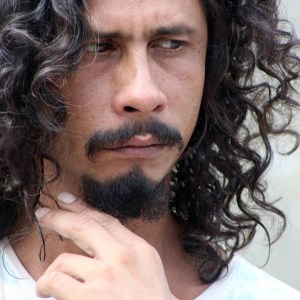
Ricardo Ariza. Fotografía: Isabela Simone.

Ricardo Ariza. Fotografía: Isabela Simone.

Ricardo Ariza, mexicano, es escritor y editor. Ha publicado el libro de poemas El título es consecuencia del azar (Colección El Ala del Tigre, UNAM, 1996). Y Física de cuerpos ausentes (Colección La Hogaza /5. Instituto de Cultura de Morelos, 2009). Así como la antología personal En donde la memoria arda (INBA, CONACULTA, Editorial Eternos Malabares, 2013). Es compilador de la Antología de cuentos latinoamericanos editada por SelloImpreso 2014; autor del manual Maíz. El sustento que da la vida. Es colaborador de la revista francesa El Café Latino

José Santos: A Mexican Artist in the United Kingdom

By Eduardo Estala Rojas


The Mexican artist José Santos (Oaxaca, 1971) arrived in London in 1997 to study art at the University of Worcester. In this exclusive interview, he tells us that he has travelled to many parts of the world and that he received a royal invitation when his work was selected for the inauguration of The Hive, Worcester’s public library. ‘The library was inaugurated by England’s Queen Elizabeth and Prince Philip and my work was part of this special event,’ Santos recounts.


José Santos.

The Mexican artist José Santos. Photograph: Mexican Cultural Centre (MCC), United Kingdom.

Santos currently works for the renowned Museum of Royal Worcester. ‘Historically it is a very important place in terms of country’s ceramics and design. Part of the collection consists of design books, drawings, paintings and ceramics. It also maintains a collection of copper plaques with exquisite engravings, dating from the 18th century until present day.’

‘I contribute to the rescue of these designs, many of which now need restoration rather than just cleaning; unfortunately, some are now beyond repair. Their restoration is very important as the designs end up being part of table pieces for the world’s royalty, so you can begin to imagine their quality, technique and artistic worth. It is an honour to participate in the recovery of the first series of 10 engravings,’ Santos explains.

In his opinion, the art made in the United Kingdom is amongst the best in the world. ‘Here you find a selection of political, controversial, aesthetic, surreal, classic and contemporary art created using different, innovative artistic media. I have had the opportunity to travel around Europe and other parts of the world. In the United Kingdom one finds a great diversity of cultures, theories and philosophical approaches by artists from all around the world that come to settle in this country, making this an exceptional place.’

He also says that to make artistic investigations pushes you to explore, travel and read: ‘Not only in search of truth, but also to discover a unique world that you have created. Why? Because it’s here where you reason, it’s here where you doubt and form your own concepts. To be an artist you should be original and find yourself through the process of doubts and answers within your mental capacity and then convert it into the best medium that you know how.’

He reflects on how he got involved in artistic practice: ‘Ever since I was little, the smell of paper, chalk or any material has been a way to communicate a moment of imagination and creativity that naturally passes through the mind. The walls of my room were my first canvases and they also resulted in my first lessons of punishment. Throughout my years in education I was in the bottom of the class; I never spoke or participated. But my notebooks were always filled drawings of my classmates’ profiles.’

He says that the artists who inspire him are María Izquierdo, Rufino Tamayo and Diego Rivera. ‘Mexico offers impressive artistic talent. It has a very rich historical and artistic culture and as a Mexican I feel privileged to have been born into a land full of inspiration.’

His work has been exhibited in Mexico and the United Kingdom, in books, museums, galleries, and public spaces, including advertisements for products. ‘I want to think that the power of exhibiting in this country is part of my contribution to Mexican art. What I would love is the opportunity to share and take back this knowledge and these experiences to Mexico. I give talks at the Museum of Royal Worcester about engravings and why they emerge in different periods and influences,’ José Santos adds.

He urges Mexican artists to work hard, ‘to value their work and exhibit it, while being critical of themselves, which is very important. There is a lot of inspiration to be had from great artists, from nature, from the unnatural. However, one must know how to make a positive change in one’s artistic philosophy, and that only emerges with experience. So go forward and do not be afraid to experiment with other artistic media,’ concludes Santos.

Translated to English by Ellen Donnison.


El pase de diapositivas requiere JavaScript.


Eduardo Estala Rojas is a Mexican poet, journalist and cultural advisor. He has worked as a correspondent in different posts for various international press agencies, as well as a critical and cultural consultant specialising in Mexico, the United States and the United Kingdom. He has obtained international awards and acknowledgement for his cultural and artistic labour. He is founder and director-general of the Mexican Cultural Centre (MCC), United Kingdom.

Jorge Domínguez Cruz

Publicamos en exclusiva en el Mexican Cultural Centre (MCC), Reino Unido, siete obras del artista indígena Jorge Domínguez Cruz, originario de Veracruz, México. Joven pintor que combina reflexiones filosóficas con motivaciones surrealistas. Los pintores que admira son Leonardo da Vinci, Turner, Salvador Dalí, Hieronymus Bosch y Pieter Brueghel the Elder. La técnica con la que se identifica es el óleo y acrílico. Actualmente radica en la ciudad de México. 


El pase de diapositivas requiere JavaScript.